Having left Colorado a few days back for the last time in 2006, it’s time for another year in review. The birding is over, so let’s see how things went....
2006 was a fun and productive year in birding for me. My state list burgeoned from 229 on January 1 to 318 as of Dec 27. 91 new state birds this year included regular seasonal visitors like the Northern Shrike, Great Egret and the Rosy-Finches, and a fair number of unusual vagrants like the White Ibis, Yellow-throated Vireo, and Hudsonian Godwit. I chased quite a few rarities, with mixed results, and I also visited some new areas of the state which allowed me to pick up other varieties which are typical in their respective habitats but not often seen in or around Fort Collins. Towards the end of the year I managed to pick up a couple really nice species, the Yellow-bellied Sapsucker and the Varied Thrush, both of which turned out to be much easier than I expected.
As in 2005 I kept a year list, to see how much I could improve on my regular bird-finding. I had 229 birds in ‘05, and sought to find 300+ in ‘06. I got close, but unfortunately came up short with just 294. I’m still pretty happy with that - 294 is a lot of birds. Off the top of my head I can think of at least 15 species that I looked long and hard for but failed to get, for various reasons. Some of that is of course blind luck, or lack thereof. Despite my best efforts I simply won’t always find what I’m looking for, and that’s not a reflection of anything in particular. Another reason I missed 300 was that I never did do the spring SE Colorado trip I thought I might earlier in the year. Sure, I visited Chico Basin Ranch a couple times, once in February (for the Long-billed Thrasher) and again in May for a Nature Conservancy-led field trip. I also was down in Pueblo in February for a Winter Raptor Survey, and in Cañon City in late September in search of the elusive Common Black Hawk (which I apparently missed only by one day). But these were very short trips, and I never did make a visit out to points further east like Lamar or John Martin Reservoir or better yet Cottonwood Canyon way down in Baca County, like I did in 2005. If I’m going to get 300+ birds in Colorado for a year, a couple days in that part of the state sure helps a lot.
I resisted for over a year since I arrived, but I finally gave in this year and started up some Colorado county lists in earnest. I had been afraid of the administrative overhead in maintaining so many additional bird lists, but the advantages in doing so have turned out to outweigh the challenges. For one, keeping county lists adds a new dimension to in-state travels, giving purpose and relevance to seeing birds in a new place that you might see quite often in more familiar and regularly-visited stomping grounds. Even Rock Pigeons are interesting if you see one while crossing into a county that you’ve never been to before - time to fire up a new list! At year’s end I have 15 county lists, ranging in length from 20 in Montrose County (which we only drove through during a SW Colorado trip back in early August), to 239 in Larimer. Weld and Boulder counties also see a lot of action, and I have 182 and 137 in them respectively, but all other counties have fewer than 100 species tallied so far.
As fun as county lists have proven to be, at this point I still don’t bird for the purpose of increasing their lengths though. In Colorado my real interests are increasing my life list and my year lists - county lists are incidental accomplishments. In time this may change, and I will possibly travel across the state just to pump up county lists. But for now I’m probably obsessed enough as it is.
So what do I hope to do next year, listwise? I’m not sure - I’ve not thought that much about it yet. I still want to see 300 species in a year, but part of me wants to wait to do a full-on Big Year and shoot for 350+. Another part of me wants to focus more on bird-finding and less on bird-chasing this coming year - that would be more in line with my belief in the real purpose of listing, which is to increase understanding of birds, their populations and distributions, and the furtherance of their conservation. That kind of focus would probably reduce my total species counts for the year, but it would increase the number of rarities for which I was the original finder, and it may well be a better use of my skills anyway, helping to cover ground that other birders aren’t focusing on.
Lastly, I started a yard list too this year. The “yard” includes any bird seen from my property, whether flying overhead or in a tree across the street. Some people have great locations and can tally 70, 80, or even a 100 species over time in their similarly-defined yards. I’m currently at 34, which I think is pretty good, but until I can create a much more bird-friendly yard and attract more songbirds, it’ll be tough to boost that number by much. My best yard birds so far are the Eurasian Collared-Dove, Hermit Thrush, and Bohemian Waxwing.
Soon I'll post some more detailed overall year-end highlights, and finally some of my nicer trip photos.
tags: birds, Colorado
Saturday, December 30, 2006

Tuesday, December 19, 2006
Varied Thrush rush
I drove out to Crow Valley campground today, having heard about a Varied Thrush that has been seen there the past couple days. Things are pretty quiet at the campground - the gate is shut, and I was the only human there. In spite of that (or perhaps because of it?) I was able to find the bird hanging out with some thrush pals (robins and solitaires) near the picnic area in just a few minutes. Here are a few views of it.
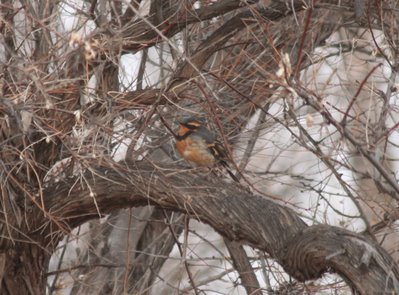
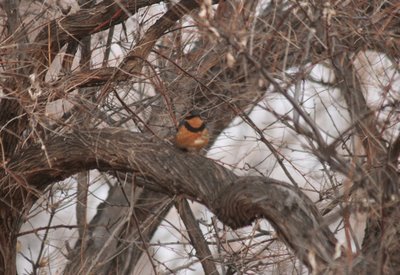
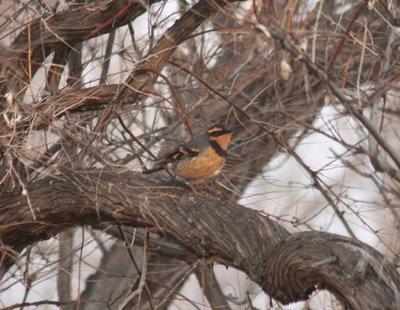
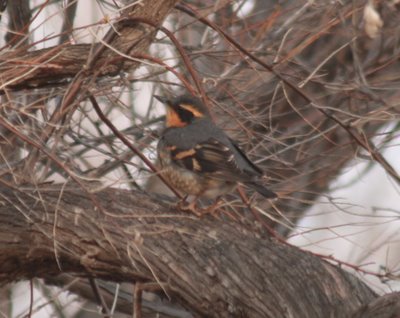
Varied Thrush is pretty rare in Colorado, and this was my first one here. It's one of favorite birds though - very handsome, like a Robin that got tired of its plain look and decided to sport a necktie or a vest.
tags: birds, thrush
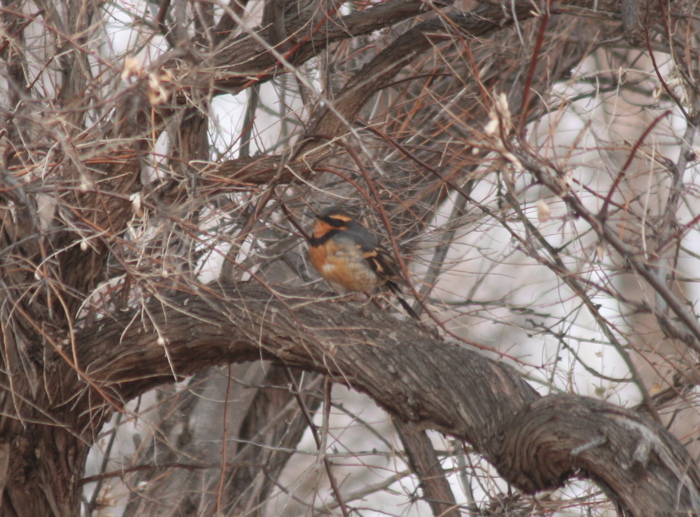
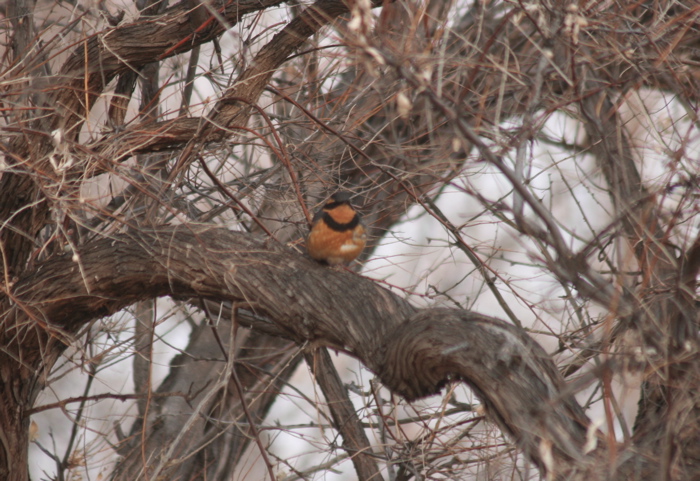
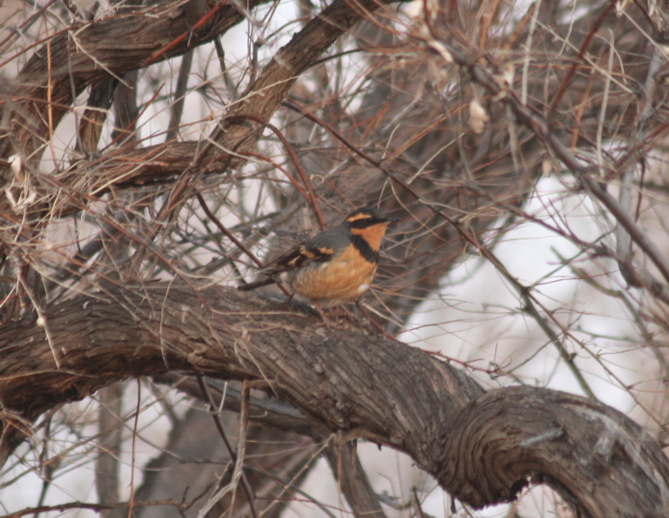

Varied Thrush is pretty rare in Colorado, and this was my first one here. It's one of favorite birds though - very handsome, like a Robin that got tired of its plain look and decided to sport a necktie or a vest.
tags: birds, thrush
Friday, October 13, 2006
Moonwalking Manakin
Actually, to me this shimmy looks a little more like the "Electric Slide" than Michael Jackson, but that's just nitpicking.
The clip doesn't make it clear, but this bird is Pipra mentalis, the Red-capped Manakin. It ranges from southern Mexico down through Central America into northern South America.
tags: birds, dance
The clip doesn't make it clear, but this bird is Pipra mentalis, the Red-capped Manakin. It ranges from southern Mexico down through Central America into northern South America.
tags: birds, dance
Thursday, September 28, 2006
500 miles. 1 bird.
Yesterday I made a trip down to Cañon City to see the Common Black-Hawk that's been reported frequently over the past few weeks. I've only seen one of this species before, in Costa Rica about 4 years ago, so I was eager to see another and to see it here in North America. The bird has been hanging out along the Arkansas River near the Mackenzie Avenue bridge (SeEtta Moss at SEColoradoBirding blog describes the situation in detail here). There'd also been Black Phoebes seen in the area too, and those weren't yet on my Colorado State Life list.
And if that weren't enough, there had also been a Scissor-tailed Flycatcher reported about 30 miles east of Pueblo, at the Otero/Pueblo county line. I had visions of having another terrific Colorado birding day like the one I had several months ago, so I set out at 4:50am to make it happen. One wrinkle though - I had to pick up my brother-in-law from the Denver Airport around 2pm, so I had to be efficient and see the birds in a timely manner if I was to get them all in, especially considering the driving involved. In other words, I needed to go 120 miles to Colorado Springs, go another 40 miles to either Cañon City or Pueblo first, and get to both the Pueblo County line (far eastern Pueblo county) AND to Cañon City (in Fremont County, 50-60 miles west of there. Either way was going to be tons of driving.
I made a decision to look for the STFL first. It took 3 hours total driving to get there, and I realized that I really only had about 20-30 minutes to look for the bird before I had to leave, if I wanted to get to the Black-Hawk spot by 10am or so. It was a calculated risk, but having had success finding a STFL last May in Arizona in a short time (hey, I haven't talked about that trip yet, have I? That's a story in itself), and knowing that the bird was seen in a very limited area, and that it should be easy to spot if it's anywhere nearby, I thought it would be worth it. Well, in the end it wasn't, because the bird was nowhere to be found. By 8:40am I was back on the road steaming toward Cañon City, hoping to get there before 10.
I made it, but it was feeling late in the morning, like I'd missed the bird already. Apparently many have seen the bird around that time, so realistically it was as good a time to be looking as any. But there weren't any other birders around, so I couldn't help but think that the Black-Hawk train had left the station. In 2+ hours I did actually see the Black Phoebe, which is a great bird for Colorado of course, and even a Western Tanager flew by. But no Black-Hawk showed up, and in general the area was very quiet, except of course for the lumbering cement trucks crossing the bridge every couple minutes. By 12:20, I had to leave, and drive 100 miles or so to the airport, and from there, another 55+ miles back to Fort Collins.
So when all was said and done, I'd bagged one new state bird, and dipped on two others. Nearly 500 miles of driving, and $30+ dollars in gas. That's pretty nuts, isn't it? Especially since I'm already thinking of trying again next week!
tags: birds, chasing
And if that weren't enough, there had also been a Scissor-tailed Flycatcher reported about 30 miles east of Pueblo, at the Otero/Pueblo county line. I had visions of having another terrific Colorado birding day like the one I had several months ago, so I set out at 4:50am to make it happen. One wrinkle though - I had to pick up my brother-in-law from the Denver Airport around 2pm, so I had to be efficient and see the birds in a timely manner if I was to get them all in, especially considering the driving involved. In other words, I needed to go 120 miles to Colorado Springs, go another 40 miles to either Cañon City or Pueblo first, and get to both the Pueblo County line (far eastern Pueblo county) AND to Cañon City (in Fremont County, 50-60 miles west of there. Either way was going to be tons of driving.
I made a decision to look for the STFL first. It took 3 hours total driving to get there, and I realized that I really only had about 20-30 minutes to look for the bird before I had to leave, if I wanted to get to the Black-Hawk spot by 10am or so. It was a calculated risk, but having had success finding a STFL last May in Arizona in a short time (hey, I haven't talked about that trip yet, have I? That's a story in itself), and knowing that the bird was seen in a very limited area, and that it should be easy to spot if it's anywhere nearby, I thought it would be worth it. Well, in the end it wasn't, because the bird was nowhere to be found. By 8:40am I was back on the road steaming toward Cañon City, hoping to get there before 10.
I made it, but it was feeling late in the morning, like I'd missed the bird already. Apparently many have seen the bird around that time, so realistically it was as good a time to be looking as any. But there weren't any other birders around, so I couldn't help but think that the Black-Hawk train had left the station. In 2+ hours I did actually see the Black Phoebe, which is a great bird for Colorado of course, and even a Western Tanager flew by. But no Black-Hawk showed up, and in general the area was very quiet, except of course for the lumbering cement trucks crossing the bridge every couple minutes. By 12:20, I had to leave, and drive 100 miles or so to the airport, and from there, another 55+ miles back to Fort Collins.
So when all was said and done, I'd bagged one new state bird, and dipped on two others. Nearly 500 miles of driving, and $30+ dollars in gas. That's pretty nuts, isn't it? Especially since I'm already thinking of trying again next week!
tags: birds, chasing
Friday, September 22, 2006
List tweaks
I just returned from a brief non-birding trip to Kansas, during which I curiously managed to do a fair amount of birding. Funny that. Anyway, I managed to see my first-ever Nashville Warbler, which was life bird #799. On the day I returned, neighbor Nick called and we went in the afternoon down to nearby Union Reservoir to look for recently reported Arctic and Least Terns. We didn't find them, but we did find a few Common Terns, and that too was a lifer me, #800.
And so, while updating my lists, I decided to do a little organizing of my taxonomic life list, where I break down my life sightings by family. I thought it might help if I ordered them as they are listed in the AOU list, where possible. (I realize that the truly kosher thing to do here is to list them in accordance with, say, Sibley-Monroe or some other world checklist, but I don't have such lists handy. All in due time, I'm sure.)
I came to realize that some taxonomic changes have occurred, and these have a bearing on my list. Not only that, I discovered that I had omitted a very commonly seen bird from my life totals - the Western Gull! That's right, perhaps one of the first birds I ever learned to identify never made it into my life totals until this week. Well, that immediately pushed me up to #801.
The Scarlet-rumped Tanager, a bird of the neotropics, was also split not long ago into Passerini's Tanager and Cherrie's Tanager. These new species generally occupy the eastern and western coastal areas in Costa Rica and Panama, and although my current lists record sightings for the bird in and around the Caribbean Slope, I do have very distinct recollections of the bird around Corcovado down along the southwest coast. So there's #802 - 2 new life birds, and I didn't even have to leave my couch!
But alas, not all was good news. While sequencing hummingbirds, I realized that I had mistakenly counted Magnificent Hummingbird twice - once in Costa Rica in 2002, and again this year when I saw it up close down at Beatty's Guest Ranch near Sierra Vista, Arizona. Ooops. Back to #801.
I'm mostly done with the list review, but a few other changes have been made, mostly in the arena of species' renaming, based on new splits. For example:
Also, the family of Dendrocolaptidae, or Woodcreepers, has been subsumed under Furnariidae, the Ovenbirds. Recent genetic evidence confirms their close association, and the decision has been made to put them all in one family, as opposed to keeping them as subfamilies under one family name. I've also moved a couple European members of Turdidae (Thrushes) to Muscicapidae, in accordance with recent decisions regarding the breakup of the family of Old World Warblers. Namely, these two species were moved from Turdidae to Muscicapidae:
* Some of these updates were tricky to make - I was able to find out about the Gray-fronted Dove change from AOU Supplement 46 to their 7th Edition, but the other ones involved consulting the latest info on their South American checklist Committee site, which annotates many of their species lists and name changes. Very informative, albeit time consuming.
tags: birds, listing
And so, while updating my lists, I decided to do a little organizing of my taxonomic life list, where I break down my life sightings by family. I thought it might help if I ordered them as they are listed in the AOU list, where possible. (I realize that the truly kosher thing to do here is to list them in accordance with, say, Sibley-Monroe or some other world checklist, but I don't have such lists handy. All in due time, I'm sure.)
I came to realize that some taxonomic changes have occurred, and these have a bearing on my list. Not only that, I discovered that I had omitted a very commonly seen bird from my life totals - the Western Gull! That's right, perhaps one of the first birds I ever learned to identify never made it into my life totals until this week. Well, that immediately pushed me up to #801.
The Scarlet-rumped Tanager, a bird of the neotropics, was also split not long ago into Passerini's Tanager and Cherrie's Tanager. These new species generally occupy the eastern and western coastal areas in Costa Rica and Panama, and although my current lists record sightings for the bird in and around the Caribbean Slope, I do have very distinct recollections of the bird around Corcovado down along the southwest coast. So there's #802 - 2 new life birds, and I didn't even have to leave my couch!
But alas, not all was good news. While sequencing hummingbirds, I realized that I had mistakenly counted Magnificent Hummingbird twice - once in Costa Rica in 2002, and again this year when I saw it up close down at Beatty's Guest Ranch near Sierra Vista, Arizona. Ooops. Back to #801.
I'm mostly done with the list review, but a few other changes have been made, mostly in the arena of species' renaming, based on new splits. For example:
- Little Hermit -> Stripe-throated Hermit
- Crowned Woodnymph -> Violet-crowned Woodnymph
- Gray-fronted Dove -> Gray-headed Dove
- Pacific Dove -> West Peruvian Dove
Also, the family of Dendrocolaptidae, or Woodcreepers, has been subsumed under Furnariidae, the Ovenbirds. Recent genetic evidence confirms their close association, and the decision has been made to put them all in one family, as opposed to keeping them as subfamilies under one family name. I've also moved a couple European members of Turdidae (Thrushes) to Muscicapidae, in accordance with recent decisions regarding the breakup of the family of Old World Warblers. Namely, these two species were moved from Turdidae to Muscicapidae:
- Black Redstart
- European Robin
* Some of these updates were tricky to make - I was able to find out about the Gray-fronted Dove change from AOU Supplement 46 to their 7th Edition, but the other ones involved consulting the latest info on their South American checklist Committee site, which annotates many of their species lists and name changes. Very informative, albeit time consuming.
tags: birds, listing
Thursday, September 07, 2006
"huffy underpants"
My dad in Florida frequently likes to send me newspaper clippings about birds from his small town (Avon Park area). There's a regular segment in the paper called "Wild Bird Sketches", and it's written by a couple bird enthusiasts, the Kowalskis. Recently they had an article about the Northern Flicker, which featured this amusing description of the bird:
Huffy underpants? Sounds like a great epithet for someone who gets riled up about things a little too easily! Come to think of it, flickers do sound a little crabby sometimes.
Obviously they meant to write "buffy underparts". I can imagine how this malapropism made its way into the article though, maybe if one of the Kowalskis was reading the description out of a book but didn't have his/her glasses on!
Anyway, I thought it was funny. An endearing mistake, to be sure.
tags: birds, malapropisms
This woodpecker is about 12 inches in length, has a brownish-olive back, barred with black and a large white spot near the tail. The huffy underpants are thickly spotted with black and there is a black crescent on the breast. ...
Huffy underpants? Sounds like a great epithet for someone who gets riled up about things a little too easily! Come to think of it, flickers do sound a little crabby sometimes.
Obviously they meant to write "buffy underparts". I can imagine how this malapropism made its way into the article though, maybe if one of the Kowalskis was reading the description out of a book but didn't have his/her glasses on!
Anyway, I thought it was funny. An endearing mistake, to be sure.
tags: birds, malapropisms
Sunday, August 20, 2006
Unexcused absence
Three months. I've been away from the blog for a little while, but I see that people have kept showing up here anyway, waiting for something, anything. Sorry about that!
Believe me, I've not left birds behind, not in the least. And I think my blog entries over the next several days will prove that.
It's rather been a case of stepping away from the blog to do other things, like enjoy the summer. I've also been focusing my online energies elsewhere, not so much in my personal blog even (which should be evident also from my lack of posting there), but instead in reading and commenting on other people's blogs. I've been interested of late in political blogs, which is quite engrossing ... or distracting, depending on how you look at such things. The good news is that I think I've got my groove back.
Just a few list notes: my neighbors alerted me to hummingbirds in their backyard a couple days ago. I was able to confirm among them a female Calliope, making it my 302nd Colorado state bird, bird #271 for the year in CO and #358 for the year in the US. It was also life bird #796, and ABA bird #463.
tags: bird lists, birds
Believe me, I've not left birds behind, not in the least. And I think my blog entries over the next several days will prove that.
It's rather been a case of stepping away from the blog to do other things, like enjoy the summer. I've also been focusing my online energies elsewhere, not so much in my personal blog even (which should be evident also from my lack of posting there), but instead in reading and commenting on other people's blogs. I've been interested of late in political blogs, which is quite engrossing ... or distracting, depending on how you look at such things. The good news is that I think I've got my groove back.
Just a few list notes: my neighbors alerted me to hummingbirds in their backyard a couple days ago. I was able to confirm among them a female Calliope, making it my 302nd Colorado state bird, bird #271 for the year in CO and #358 for the year in the US. It was also life bird #796, and ABA bird #463.
tags: bird lists, birds
Wednesday, May 10, 2006
Yellow-throated Vireo
 I got a call from a friend this morning telling me about a Yellow-throated Vireo that she found in Lee Martinez Park in downtown Fort Collins. Oooo, another lifer opportunity, I thought. So I jammed down there, and with the help of another fellow, I was able to find the bird real quick-like.
A very handsome bird, singing sporadically and sounding much like his "Solitary Vireo" cousins. I don't always get these kind of gratifying chase results, and I'm thrilled to also get a decent photo of it. My blog probably makes it seem like I get plenty of good photos from my birding experiences, but that's misleading - I often post the successes, and (obviously) never the failures, of which there are plenty.
tags: birds, Fort Collins
Thursday, March 23, 2006
The Fremont Street Experience
 One other amusing bird-related experience we had in Vegas was the Fremont Street Experience, a block-long archway of lights over Fremont Street in downtown that act as a movie-screen for passersby on their way to casinos and shops. High-wattage speakers also line the street providing booming audio. One of their shows is called "American Freedom", a 4-minute long rip-roaring, flag-waving bonanza to the music of John Philip Sousa.
At the conclusion of the piece, a Bald Eagle soars across the screen, and we got to hear the eagle's call. Or rather, we got to hear what the vast majority of America seems to think an eagle call sounds like -- an aggressive, extended high-pitched keeeeerrrrrrr, suspiciously similar to that of a Red-tailed Hawk.
I just think it would be hilarious if the audience could hear what a Bald Eagle really sounds like. Heads would explode from the cognitive dissonance of realizing that our majestic national bird emits whimpering cackles instead of a clarion screech. Of course, that realism would take away from the triumphalist image of the bird, so on we go, perpetuating Bald Eagle myths based only on its striking size and plumage.
Although, perhaps to its long-term benefit - you could argue that the species is well-served by Americans' misconception of its call, which fits a preconceived notion of menace and thus makes the bird more sympathetic to Americans than it otherwise might be. Eagles get shot enough as it is, and there's no need to reduce its stature in the eyes of a country with a history of killing these remarkable creatures.
tags: Bald Eagle, Las Vegas, Fremont Street
Blogless in Las Vegas
I got back a week ago from a 3-day trip to Las Vegas with my wife, and I've been delinquent in writing anything new here since. Part of it is because as you might expect it wasn't really a bird trip, and as you may have noticed I'm slavishly devoted to bird-only content here. Yes, we did go for a hike one day at Red Rock National Conservation Area, and I even got a few good pics while there. But there was plenty else going on in more urban settings, which was really the point of the trip.
I think the other reason I've not been writing is to save some 'birding' energy for the upcoming migration season. I want to make the most of this coming spring, and with a planner full of scheduled activities already, I expect that I'm going to be in the field a lot the next two months. So instead I've been distracting myself with other interests like watching movies and, oh yeah, doing my taxes (which are horrendous enough, and not very blogworthy). Not that that's an interest of mine...I guess that came out funny.
In any case, onto the wildlife.
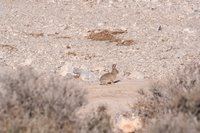 The first critters we came across were actually a pair of Desert Cottontails. As I prepared to get a photo of one, it darted out of view but was conveniently replaced by its buddy, who ended up in the exact same pose and position as the first.
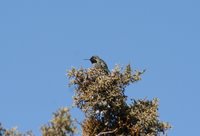 I also tallied my first hummingbird of the year, this Anna's Hummingbird which perched nicely on the top of a juniper.
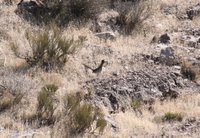 The real birdwatching highlight for the whole trip came when I heard some rustling in the ravine below the Keystone Thrust trail. Following a dry rattle, this Greater Roadrunner emerged, enchanting both me and my wife. She likes birdwatching as much as I do, as long as the birds are big enough to be seen without the need for optics.
 Lastly came this Western Scrub Jay, which I took as we were heading out of the park around noonish. It was perched on a yucca so close to the road I couldn't resist.
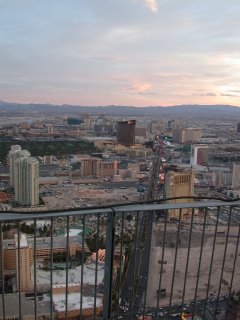
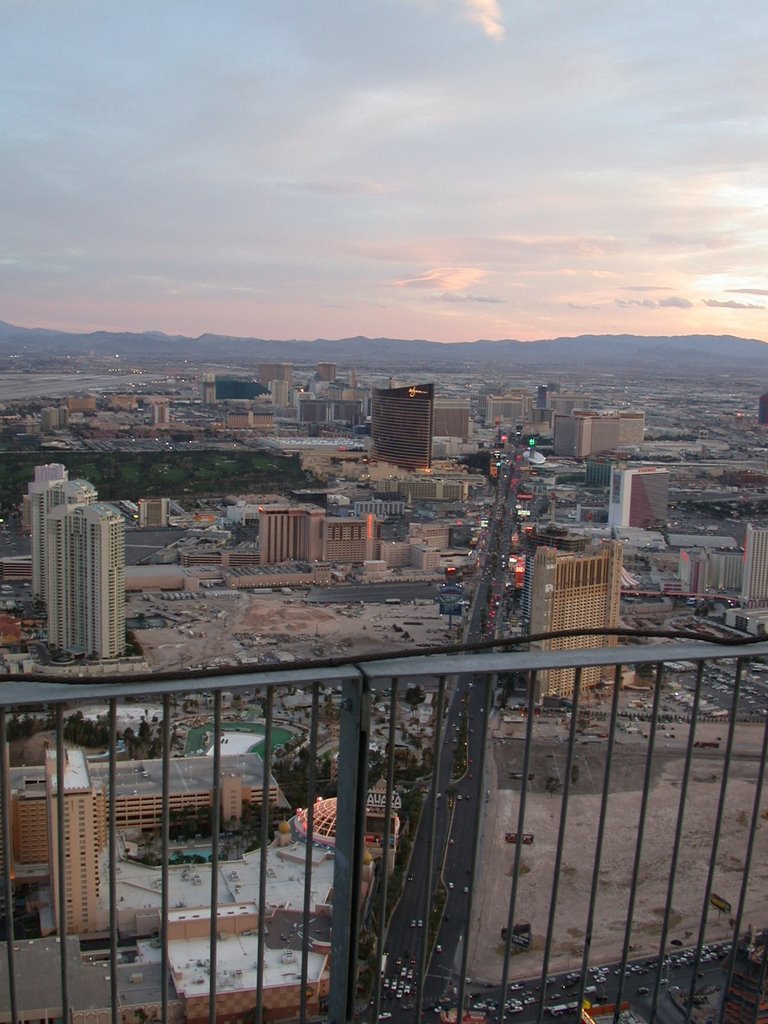
And lastly, not a bird, but rather a birds-eye view of Las Vegas at sunset, as seen from the top of the Stratosphere tower on the Strip:
tags: birds Las Vegas
I think the other reason I've not been writing is to save some 'birding' energy for the upcoming migration season. I want to make the most of this coming spring, and with a planner full of scheduled activities already, I expect that I'm going to be in the field a lot the next two months. So instead I've been distracting myself with other interests like watching movies and, oh yeah, doing my taxes (which are horrendous enough, and not very blogworthy). Not that that's an interest of mine...I guess that came out funny.
In any case, onto the wildlife.
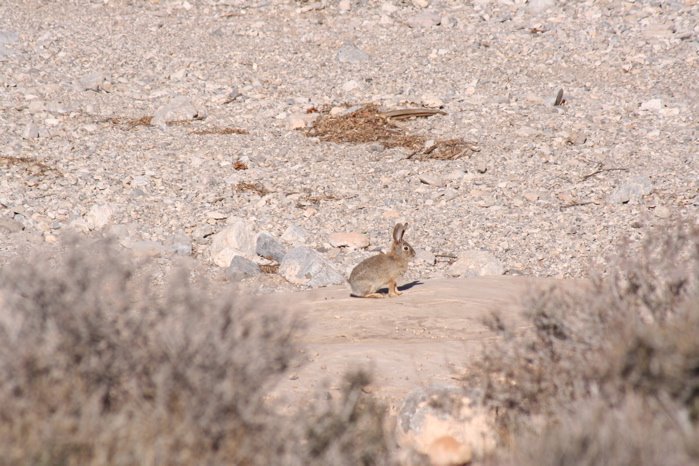 The first critters we came across were actually a pair of Desert Cottontails. As I prepared to get a photo of one, it darted out of view but was conveniently replaced by its buddy, who ended up in the exact same pose and position as the first.
 I also tallied my first hummingbird of the year, this Anna's Hummingbird which perched nicely on the top of a juniper.
 The real birdwatching highlight for the whole trip came when I heard some rustling in the ravine below the Keystone Thrust trail. Following a dry rattle, this Greater Roadrunner emerged, enchanting both me and my wife. She likes birdwatching as much as I do, as long as the birds are big enough to be seen without the need for optics.
 Lastly came this Western Scrub Jay, which I took as we were heading out of the park around noonish. It was perched on a yucca so close to the road I couldn't resist.
And lastly, not a bird, but rather a birds-eye view of Las Vegas at sunset, as seen from the top of the Stratosphere tower on the Strip:
tags: birds Las Vegas
Monday, March 13, 2006
Weekend Bird Review
For some of us, the weekend goes 'til Monday. :^)
In any case, I got to see some nice birds the past couple days. Here are some of my better photos...
 Sunday morning I made a trip to Connie Kogler's home in southwest Loveland, to take a gander at a rare Larimer County Sage Sparrow that has been frequenting her feeders the past few days. I got some very nice looks at it, as you can tell. This was only my second sighting ever of this bird (the first being about 7 years ago in Death Valley National Park), so yes, I was stoked.
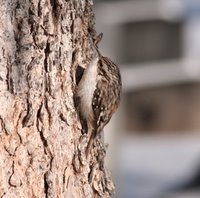 This morning I dropped by the Grandview Cemetary here in Fort Collins. It was lovely but chilly, having snowed the night before and then clearing off before sunrise. Even this Brown Creeper felt the chill, and puffed his feathers up a bit to stay warm. I was surprised at how docile he was, allowing me to get quite close and take quite a few shots without raising any fuss. It's always a delicate thing, deciding what constitutes a respectful distance from a subject bird. I used my best judgment, edging closer over a couple minutes time.
 My main plan for Monday was to do some Boulder County birding, but on the way down I made an impromptu addendum to try to find a special sparrow down in Littleton that eluded me a week or two ago. I realized while driving that I'd get there shortly after 10am, which was reportedly the best time of day to find the bird. When I got there, I easily found this White-crowned Sparrow, hanging out in one of the bushes at the site.
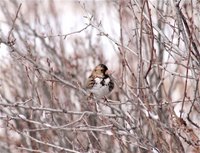 Then, a couple minutes later, the target bird finally emerged. It was a bit of a skulker, forcing me to take several rather crummy shots of it half-hidden amongst twigs and other less-secretive sparrows. This Harris' Sparrow was a lifer for me, and upon seeing it there was much rejoicing across the land. These two sparrow shots were taken at the Carson Nature Center near the Platte River in Littleton.
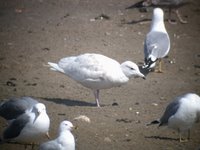 I eventually made my way to Boulder County, where I initially stopped at Erie Reservoir in Lafayette. As had been reported on the COBirds listserv, it was quite active, with about 600 birds there. Very quickly I managed to spot this 1st or 2nd-winter Glaucous Gull - it was hard to miss with its white plumage and large size standing out among the numerous Ring-billed and California Gulls present. Later at Thomas Reservoir less than a mile away as the gull flies were hundreds more birds, including a Franklin's and a Lesser Black-backed, both adults in breeding plumage. (Thanks to Steve Larson who I linked up with today, who pointed me toward Thomas as a good gull spot.)
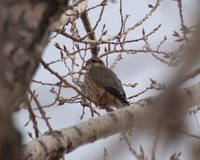 Finally, on my way home I stopped by Cattail Pond in Loveland for a quick look at the waterfowl. I've been hoping to find a Ruddy Duck this winter, and I've had no luck so far. But while scanning the water I heard some squealing overhead, and by the time I figured out what was going on one of the two birds tussling landed in a nearby tree. I don't know what the other bird was, but this was a Merlin which let me get close enough for this SLR shot from below. A nice conclusion to a birdy day, and weekend.
And like this Merlin I'm taking off for a couple days with my wife so she can enjoy some much-deserved R&R. I'll be back by next weekend (meaning the one that most people recognize as such). Ciao for now!
tags: birds, Colorado
In any case, I got to see some nice birds the past couple days. Here are some of my better photos...
 Sunday morning I made a trip to Connie Kogler's home in southwest Loveland, to take a gander at a rare Larimer County Sage Sparrow that has been frequenting her feeders the past few days. I got some very nice looks at it, as you can tell. This was only my second sighting ever of this bird (the first being about 7 years ago in Death Valley National Park), so yes, I was stoked.
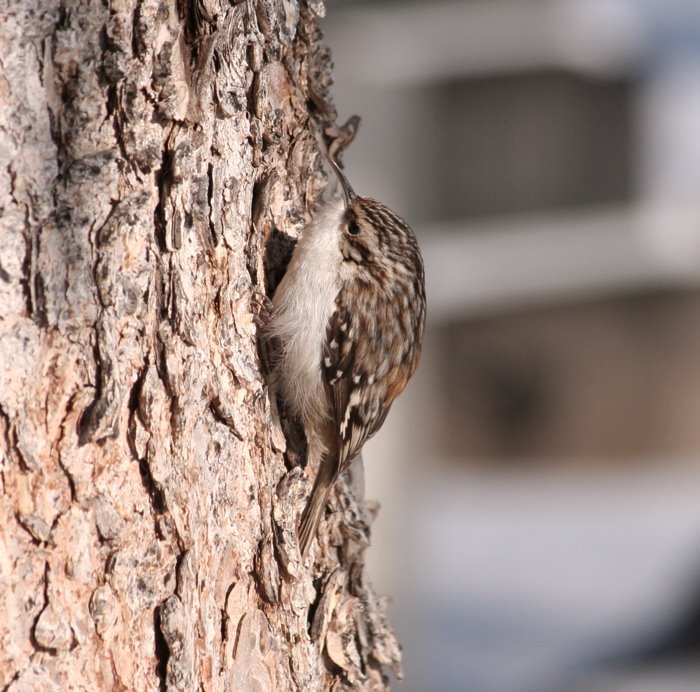 This morning I dropped by the Grandview Cemetary here in Fort Collins. It was lovely but chilly, having snowed the night before and then clearing off before sunrise. Even this Brown Creeper felt the chill, and puffed his feathers up a bit to stay warm. I was surprised at how docile he was, allowing me to get quite close and take quite a few shots without raising any fuss. It's always a delicate thing, deciding what constitutes a respectful distance from a subject bird. I used my best judgment, edging closer over a couple minutes time.
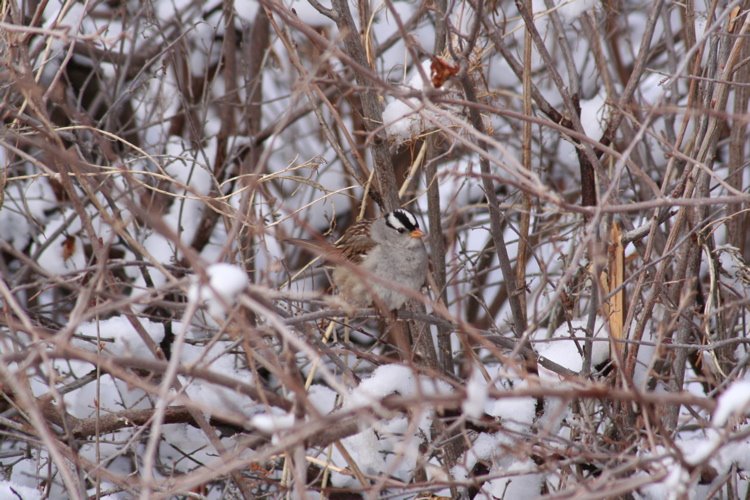 My main plan for Monday was to do some Boulder County birding, but on the way down I made an impromptu addendum to try to find a special sparrow down in Littleton that eluded me a week or two ago. I realized while driving that I'd get there shortly after 10am, which was reportedly the best time of day to find the bird. When I got there, I easily found this White-crowned Sparrow, hanging out in one of the bushes at the site.
 Then, a couple minutes later, the target bird finally emerged. It was a bit of a skulker, forcing me to take several rather crummy shots of it half-hidden amongst twigs and other less-secretive sparrows. This Harris' Sparrow was a lifer for me, and upon seeing it there was much rejoicing across the land. These two sparrow shots were taken at the Carson Nature Center near the Platte River in Littleton.
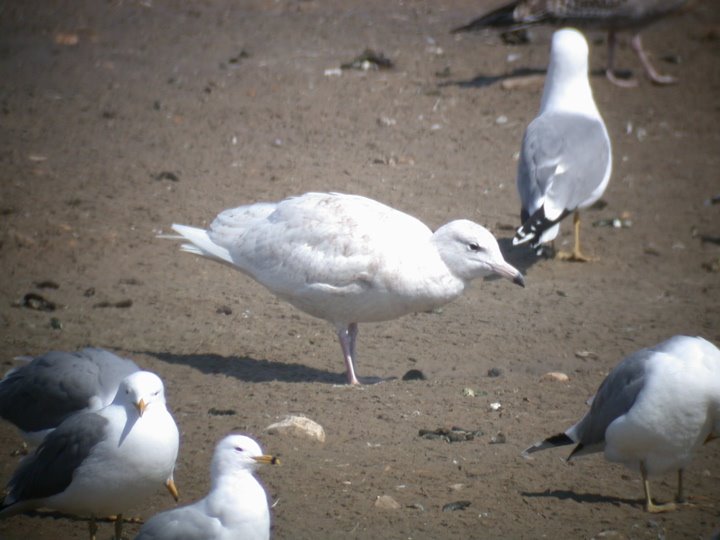 I eventually made my way to Boulder County, where I initially stopped at Erie Reservoir in Lafayette. As had been reported on the COBirds listserv, it was quite active, with about 600 birds there. Very quickly I managed to spot this 1st or 2nd-winter Glaucous Gull - it was hard to miss with its white plumage and large size standing out among the numerous Ring-billed and California Gulls present. Later at Thomas Reservoir less than a mile away as the gull flies were hundreds more birds, including a Franklin's and a Lesser Black-backed, both adults in breeding plumage. (Thanks to Steve Larson who I linked up with today, who pointed me toward Thomas as a good gull spot.)
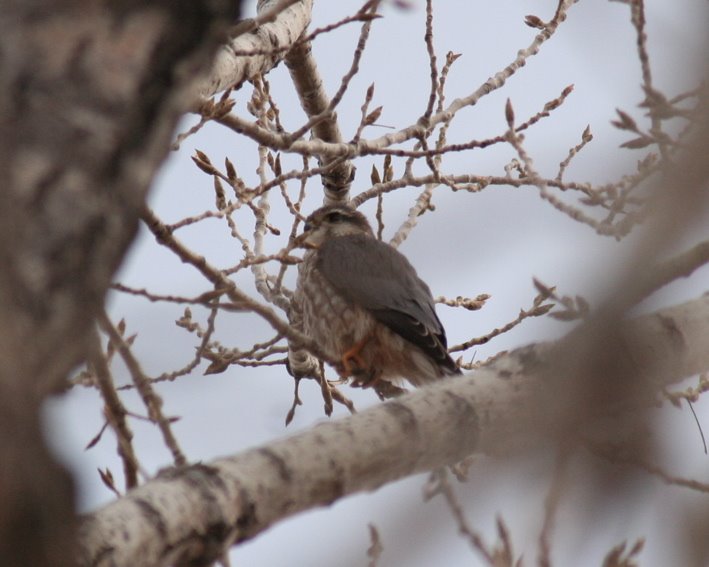 Finally, on my way home I stopped by Cattail Pond in Loveland for a quick look at the waterfowl. I've been hoping to find a Ruddy Duck this winter, and I've had no luck so far. But while scanning the water I heard some squealing overhead, and by the time I figured out what was going on one of the two birds tussling landed in a nearby tree. I don't know what the other bird was, but this was a Merlin which let me get close enough for this SLR shot from below. A nice conclusion to a birdy day, and weekend.
And like this Merlin I'm taking off for a couple days with my wife so she can enjoy some much-deserved R&R. I'll be back by next weekend (meaning the one that most people recognize as such). Ciao for now!
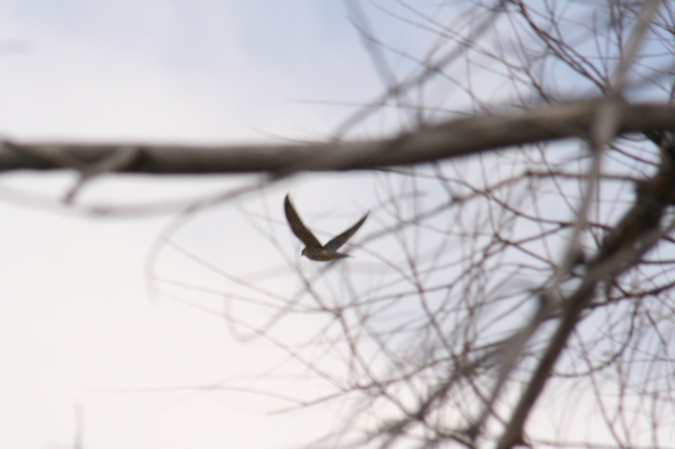
tags: birds, Colorado
Thursday, March 09, 2006
More navel-gazing
A Great Black-backed Gull spent a few days on Rist Benson Reservoir here in Larimer County last January, and on 1/20 I digiscoped several decent shots of it in very good light, with the idea that I might submit a report of the sighting to the Colorado Bird Records Committee (CBRC). Well, a couple days ago I finally did submit a report of that sighting to the CBRC. Whether my report and accompanying photos will be good enough to merit confirmation by the committee remains to be seen, although I suspect they will. In any case it was an important step for me in my continuing evolution as a birder, to make a concerted effort in documenting my observations for the benefit of others.
I've written several times on this topic of personal evolution now, noting how differently I approach this hobby of mine from how I did several years ago. At some point I hope to tire of it, and devote my writing energies solely to the subject matter itself, but during the process of submitting that report I was struck by one particularly sharp contrast between "then" and "now", which is actually kinda funny, but also one that I think is interesting to explore.
Part of the CBRC record report form requires delineation of differences between the bird species you think you saw with those of similar-looking species; i.e., how did you know it was a Great Black-backed Gull and not some other gull. In the case of the GBBG, similar North American occurrences include other rarities like the Slaty-backed Gull and the Yellow-footed Gull, neither of which I've seen before. But I took the time to investigate them, especially in the Olsen/Larsson book on Northern Hemisphere gulls. It was then that I made an amusing realization about my evolution as a birding enthusiast.
As recently as 4 years ago, I would never have taken the time to study a species of bird I'd never seen before. That in itself isn't necessarily unusual or damning - beginners or novices don't often take the time for indepth study of unfamiliar birds. But in my case, it wasn't that I didn't have the time, or was confused enough just learning the birds that I had seen. Rather, it was that I purposefully didn't want to spoil the joy or surprise that comes from beholding a bird when you encounter it for the first time. I even felt that knowing its name beforehand seemed to pollute the sense of wonderment.
Where did this bizarre conception come from? I recall a highly formative experience back in 1998, shortly after I moved from Davis, California (where I went to grad school) to the Bay Area (where I started my first job). My first social bird experiences were with the Sequoia Audubon Society on the Peninsula, and at one of my first meetings there was a presentation from someone who went to Alaska and the North Pacific. He had some terrific pictures of species I'd never seen or heard of before, and I was enthralled. Kittlitz's Murrelet, Red-faced Cormorant, Spectacled Eider...it was exciting to think of all the great bird species out there that I had yet to learn about. World birds were like the candies in Willy Wonka's factory - magical and brilliant, mysterious and alluring.
But I then perceived a risk to my future experiences of seeing new birds - that of knowing too much beforehand. I feared that the magic, brilliance, mystery and allure of these birds would be diminished if I'd read too much or seen too many photos of them in advance. Wasn't part of the thrill of exploration not knowing what lies beyond the next bend in the river, or on the other side of the mountain? In that vein I think I subconsciously resolved to put the blinders on, to not to delve too deeply into bird guide books, and instead to just wait for the birds to reveal themselves to me. I didn't want birding to be a science - I already was a scientist, and birding was an artsier side-interest. I wanted to adhere to this aesthetic, an almost-romantic notion of what it meant to be on a journey of pure discovery - even a forced, false one - in which the discoveries would be not for furthering the knowledge of posterity, but solely for my own feeling of bedazzlement.
And it was easy to accommodate this desire until recently, because for various reasons my birding was still a very solitary activity. I did actually yearn to join bird clubs and go on group outings, but my work schedule made that quite difficult, and besides, birding was more personal therapy than an effort to contribute to the broader birding community knowledge base. But after moving to Colorado, where I had gobs more time and a youthful, active birding community to join, my objectives changed fairly rapidly. I think I did continue to bask in willful bird ignorance for a short time; but the newness of the area and the feeling that I had external expectations on me from locals because of my claims of being an avid birder inspired me to give up this phony notion of "not wanting to ruin the surprise" and actually start to have some real idea of what I was talking about.
At this point I freely admit that I haven't really foregone the joy and wonder in seeing new birds when I study them before actually seeing them. What I've realized over time is that the ideal I was hoping to uphold after that Sequoia Audubon meeting in 1998 has been sublimated to a different form of gratification, one derived from the sharing of knowledge and the unraveling of mystery, and not in simply pretending that me not knowing something constitutes a state of purity to be cherished. Furthermore, I now recognize that learning what I can about birds beforehand just accelerates me to the next mysteries, like "What is that bird doing here this time of year?" or "How has convergent evolution made this species so similar to this other one on another continent?"
What it comes down to is that I now trust that I won't run out of things to be amazed at. Nature seems to do a good job at presenting conundrums, and learning what you can when you can about it doesn't diminish its marvel or grandeur. And maybe it's silly that I had to come to this understanding in such a roundabout fashion; but looking back, how could I have arrived here any differently?
tags: birding, navel gazing
I've written several times on this topic of personal evolution now, noting how differently I approach this hobby of mine from how I did several years ago. At some point I hope to tire of it, and devote my writing energies solely to the subject matter itself, but during the process of submitting that report I was struck by one particularly sharp contrast between "then" and "now", which is actually kinda funny, but also one that I think is interesting to explore.
Part of the CBRC record report form requires delineation of differences between the bird species you think you saw with those of similar-looking species; i.e., how did you know it was a Great Black-backed Gull and not some other gull. In the case of the GBBG, similar North American occurrences include other rarities like the Slaty-backed Gull and the Yellow-footed Gull, neither of which I've seen before. But I took the time to investigate them, especially in the Olsen/Larsson book on Northern Hemisphere gulls. It was then that I made an amusing realization about my evolution as a birding enthusiast.
As recently as 4 years ago, I would never have taken the time to study a species of bird I'd never seen before. That in itself isn't necessarily unusual or damning - beginners or novices don't often take the time for indepth study of unfamiliar birds. But in my case, it wasn't that I didn't have the time, or was confused enough just learning the birds that I had seen. Rather, it was that I purposefully didn't want to spoil the joy or surprise that comes from beholding a bird when you encounter it for the first time. I even felt that knowing its name beforehand seemed to pollute the sense of wonderment.
Where did this bizarre conception come from? I recall a highly formative experience back in 1998, shortly after I moved from Davis, California (where I went to grad school) to the Bay Area (where I started my first job). My first social bird experiences were with the Sequoia Audubon Society on the Peninsula, and at one of my first meetings there was a presentation from someone who went to Alaska and the North Pacific. He had some terrific pictures of species I'd never seen or heard of before, and I was enthralled. Kittlitz's Murrelet, Red-faced Cormorant, Spectacled Eider...it was exciting to think of all the great bird species out there that I had yet to learn about. World birds were like the candies in Willy Wonka's factory - magical and brilliant, mysterious and alluring.
But I then perceived a risk to my future experiences of seeing new birds - that of knowing too much beforehand. I feared that the magic, brilliance, mystery and allure of these birds would be diminished if I'd read too much or seen too many photos of them in advance. Wasn't part of the thrill of exploration not knowing what lies beyond the next bend in the river, or on the other side of the mountain? In that vein I think I subconsciously resolved to put the blinders on, to not to delve too deeply into bird guide books, and instead to just wait for the birds to reveal themselves to me. I didn't want birding to be a science - I already was a scientist, and birding was an artsier side-interest. I wanted to adhere to this aesthetic, an almost-romantic notion of what it meant to be on a journey of pure discovery - even a forced, false one - in which the discoveries would be not for furthering the knowledge of posterity, but solely for my own feeling of bedazzlement.
And it was easy to accommodate this desire until recently, because for various reasons my birding was still a very solitary activity. I did actually yearn to join bird clubs and go on group outings, but my work schedule made that quite difficult, and besides, birding was more personal therapy than an effort to contribute to the broader birding community knowledge base. But after moving to Colorado, where I had gobs more time and a youthful, active birding community to join, my objectives changed fairly rapidly. I think I did continue to bask in willful bird ignorance for a short time; but the newness of the area and the feeling that I had external expectations on me from locals because of my claims of being an avid birder inspired me to give up this phony notion of "not wanting to ruin the surprise" and actually start to have some real idea of what I was talking about.
At this point I freely admit that I haven't really foregone the joy and wonder in seeing new birds when I study them before actually seeing them. What I've realized over time is that the ideal I was hoping to uphold after that Sequoia Audubon meeting in 1998 has been sublimated to a different form of gratification, one derived from the sharing of knowledge and the unraveling of mystery, and not in simply pretending that me not knowing something constitutes a state of purity to be cherished. Furthermore, I now recognize that learning what I can about birds beforehand just accelerates me to the next mysteries, like "What is that bird doing here this time of year?" or "How has convergent evolution made this species so similar to this other one on another continent?"
What it comes down to is that I now trust that I won't run out of things to be amazed at. Nature seems to do a good job at presenting conundrums, and learning what you can when you can about it doesn't diminish its marvel or grandeur. And maybe it's silly that I had to come to this understanding in such a roundabout fashion; but looking back, how could I have arrived here any differently?
tags: birding, navel gazing
Tuesday, March 07, 2006
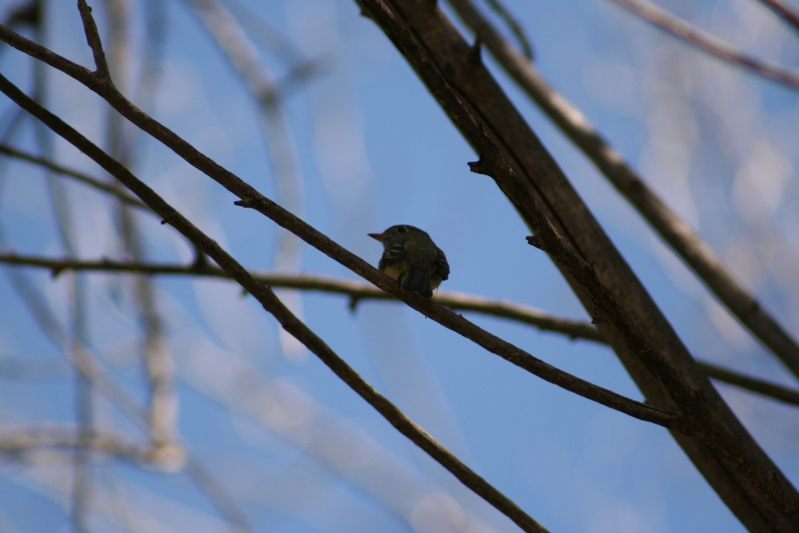
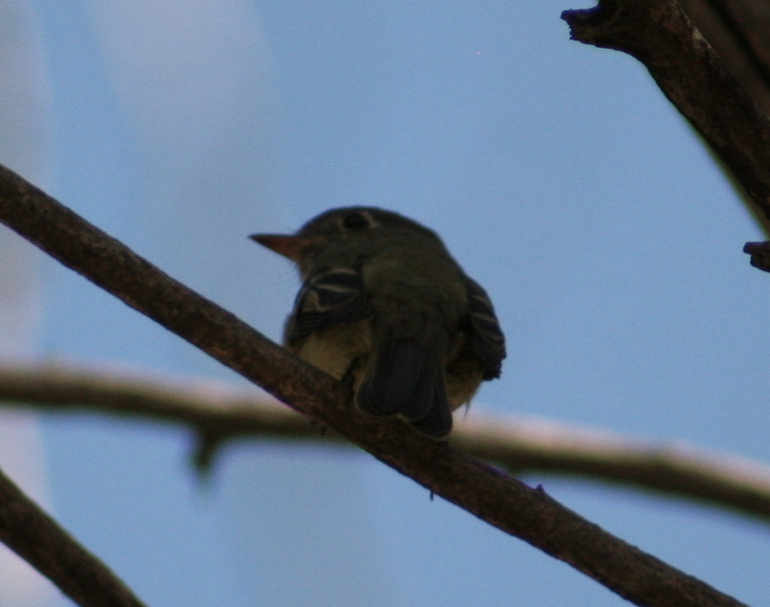
Name That Empid
(Update, 2:30pm: It didn't take long for some to point out that I had originally posted a pic of a Townsend's Solitaire. I should have known I'd embarrass myself somehow.
Anyway, I've updated the images and text to discuss the other bird I saw that day, which I know is an Empid. Otherwise, everything else is the same.)
While browsing my photo collection I came across a photo that I had previously forgotten about. Back in September on the same day that I drove out to Prewitt Reservoir to see the Curlew Sandpiper, I also drove up to Crow Valley Campground mid-day to check out the migrant situation. After a short walk I found an Empidonax flycatcher, although at the time I wasn't able to positively identify it. But I had just purchased my Canon Digital Rebel XT and with a little chasing I got some good shots of it, and hoped to figure out what it was after I got home.
But for whatever reason I filed the photos on my new laptop in a completely different directory from all the other bird pics, and so it remained unseen until yesterday's re-discovery.Looking at the pics now, I can see that in fact I saw two different Empid flycatchers. One of them is shown here (the one for which I have the better shot), and I'm hoping I can solicit some ideas on which one it was, even though these pics are far from ideal. It'll be interesting to see if someone more confident in their Empid ID skills suggests the same bird(s) I'm thinking. Any ID pros out there want to take a stab at it?
There are really just two pics here - each pair consists of an original shot and a zoom-in to show just the bird.
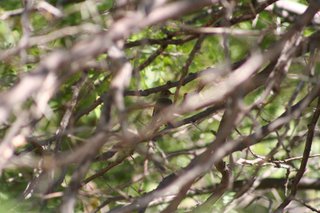
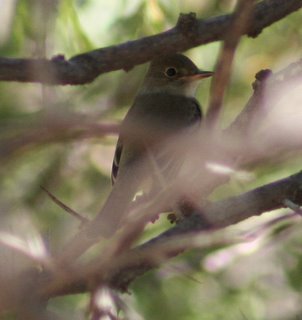
Oh yeah, before I forget - these were taken early afternoon on Sept 19, 2005. Crow Valley Campground is a small riparian "migrant trap" amid farmland and shortgrass prairie located in Weld County, about 60 miles east of the Front Range of the Rocky Mountains in northeastern Colorado. The bird was (not surprisingly) silent.
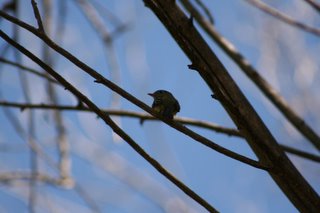
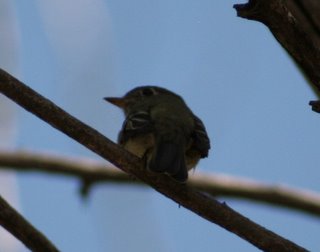
If we can nail this down, I'll put up the pics for the other bird, for a real challenge. :^)
tags: empid, bird identification, birds
Anyway, I've updated the images and text to discuss the other bird I saw that day, which I know is an Empid. Otherwise, everything else is the same.)
While browsing my photo collection I came across a photo that I had previously forgotten about. Back in September on the same day that I drove out to Prewitt Reservoir to see the Curlew Sandpiper, I also drove up to Crow Valley Campground mid-day to check out the migrant situation. After a short walk I found an Empidonax flycatcher, although at the time I wasn't able to positively identify it. But I had just purchased my Canon Digital Rebel XT and with a little chasing I got some good shots of it, and hoped to figure out what it was after I got home.
But for whatever reason I filed the photos on my new laptop in a completely different directory from all the other bird pics, and so it remained unseen until yesterday's re-discovery.
There are really just two pics here - each pair consists of an original shot and a zoom-in to show just the bird.

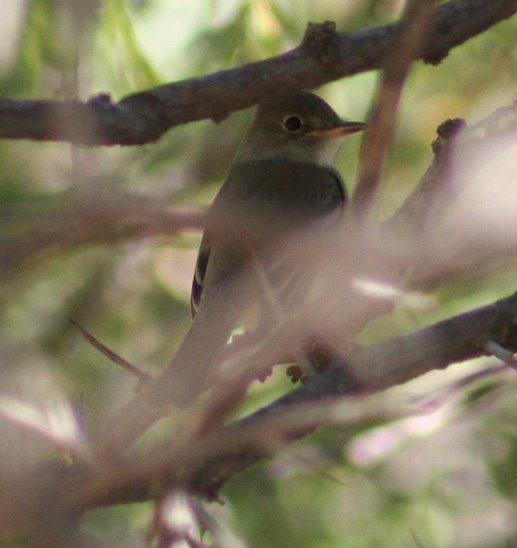
Oh yeah, before I forget - these were taken early afternoon on Sept 19, 2005. Crow Valley Campground is a small riparian "migrant trap" amid farmland and shortgrass prairie located in Weld County, about 60 miles east of the Front Range of the Rocky Mountains in northeastern Colorado. The bird was (not surprisingly) silent.
tags: empid, bird identification, birds
Monday, March 06, 2006
The First Goshawk Is Always the Hardest
Last Saturday I went out with the Boulder Bird Club on their annual search for late-season Winter Finches, in the high country west of town. The highlight and focus of the outing of course is Allenspark, which if you recall is renowned for their wintering Rosy-Finches.
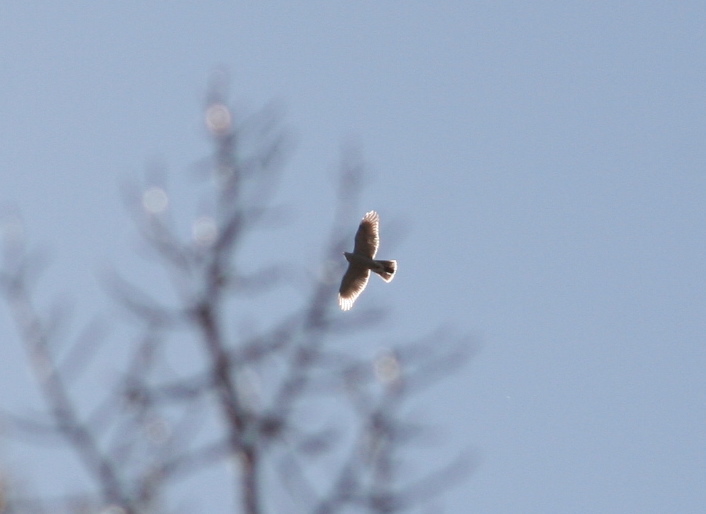
 Initially the group centered on the Fawn Brook Inn, but after about 15 minutes of finchless feeders, we ambled up the road looking for other feeders and any other activity in the pines around town. That did turn out to be fruitful, as we found Cassin's Finches and a single female Pine Grosbeak. Then suddenly someone said there was a buteo overhead. Hmmm, a buteo here at 8500 feet just down the slope from Longs Peak? I looked up and saw a very buteo-like bird circling overhead in the wind about 75 feet up; except that it was very pale grayish-blue underneath, not like any buteo I could think of except for Gray Hawk, which this obviously wasn't. I trained my binos on the bird, but it was almost directly overhead, so I couldn't see head markings. And when it wasn't directly overhead it was obscured by the towering pines all around. I was thinking Northern Goshawk, but was afraid to call it out, having never positively ID'ed one in the field before. Fortunately it didn't dash off completely, and I was able to snap a single shot of it after it had drifted even further up. By the time it soared out of sight our group consensus settled that we had indeed seen a Goshawk. A life bird for me, at long last!
Yeah, it's not a terribly great shot, although it does capture the gist of the bird as we observed it. What convinced me most of all (not seen in this photo, but clear to us when the bird was lower) was the very distinctive underwing coloration, in concert with its strong morphological characters (wing shape, head size, and tail breadth). I've wanted to see a Goshawk for several years now, but never during the 5 or so previous possible occasions did I see the bird well enough to confidently identify it as such. Finally, on an outing where we were looking for finches, I managed a fairly sustained look at one. Go figure. Hopefully the next Goshawk won't take me years to find.
It served to remind me that when it comes to accipiters, you should always be prepared to see one if you're anywhere near reasonable habitat. Coopers and Sharpies (and apparently Goshawks too) always seem to be "popping in", and just as quickly popping out. When that has happened before, I always think in retrospect that it should have been obvious that one might show up, and swear to myself that next time - always next time - I'll keep an eye out. Once again I forgot my own advice, but luckily I had the Boulder Bird Club to bail me out.
tags: birding, Boulder Bird Club, goshawk
 Initially the group centered on the Fawn Brook Inn, but after about 15 minutes of finchless feeders, we ambled up the road looking for other feeders and any other activity in the pines around town. That did turn out to be fruitful, as we found Cassin's Finches and a single female Pine Grosbeak. Then suddenly someone said there was a buteo overhead. Hmmm, a buteo here at 8500 feet just down the slope from Longs Peak? I looked up and saw a very buteo-like bird circling overhead in the wind about 75 feet up; except that it was very pale grayish-blue underneath, not like any buteo I could think of except for Gray Hawk, which this obviously wasn't. I trained my binos on the bird, but it was almost directly overhead, so I couldn't see head markings. And when it wasn't directly overhead it was obscured by the towering pines all around. I was thinking Northern Goshawk, but was afraid to call it out, having never positively ID'ed one in the field before. Fortunately it didn't dash off completely, and I was able to snap a single shot of it after it had drifted even further up. By the time it soared out of sight our group consensus settled that we had indeed seen a Goshawk. A life bird for me, at long last!
Yeah, it's not a terribly great shot, although it does capture the gist of the bird as we observed it. What convinced me most of all (not seen in this photo, but clear to us when the bird was lower) was the very distinctive underwing coloration, in concert with its strong morphological characters (wing shape, head size, and tail breadth). I've wanted to see a Goshawk for several years now, but never during the 5 or so previous possible occasions did I see the bird well enough to confidently identify it as such. Finally, on an outing where we were looking for finches, I managed a fairly sustained look at one. Go figure. Hopefully the next Goshawk won't take me years to find.
It served to remind me that when it comes to accipiters, you should always be prepared to see one if you're anywhere near reasonable habitat. Coopers and Sharpies (and apparently Goshawks too) always seem to be "popping in", and just as quickly popping out. When that has happened before, I always think in retrospect that it should have been obvious that one might show up, and swear to myself that next time - always next time - I'll keep an eye out. Once again I forgot my own advice, but luckily I had the Boulder Bird Club to bail me out.
tags: birding, Boulder Bird Club, goshawk
Sunday, March 05, 2006
Solo
(NOTE: I actually composed most of this on Feb 28, but hadn't gotten around to finish it for posting. Apologies for my unexplained absence.)
I got up very early this morning to do something I've never done before - go owling solo.
The biggest trouble of course is dragging yourself out of bed. It's nice and cozy there, whereas the outside world promises only cold and makes pestering demands of consciousness and mental acuity. Still, you can't get it out of your head that in the dead of night -there- -are- -owls- -out- -there-, so you force yourself up, even as the clock says 5 minutes after 3 a.m.
After the first 5 or 10 minutes though, the drowsiness gives way to excitement, especially as you become aware that virtually everyone else is still fast asleep, leaving you and only you as the sentinel. Pitch dark with the new moon, and no cars on the road - at least for a time, the world seems to belong only to you.
I drove up Rist Canyon Rd, since I'd heard that was a good area to look for small owls. I'm in dire need of seeing, or at least hearing, small owls, like Eastern Screech-Owl, Northern Saw-Whet Owl, Boreal Owl, and Northern Pygmy Owl. After driving a couple miles in, I got out of my truck and just listened. Silence. I then practiced a few of my Saw-Whet pip calls, and after just a minute, a Great Horned Owl some ways up the canyon hooted back. Wow! I'd never had a conversation before with an owl. Granted, I was probably just pissing it off, smack-talking like some intruder owl, but still, we were communicating. It sounds trivial, but it was surprisingly visceral.
I made a few other stops in the next hour or so, but hadn't elicited much else in response until I returned to more or less the same spot I started. I pipped again, and this time, I got a real Saw-Whet reply. It sounded fairly close, and I clambered a short ways off the road in hopes of getting my flashlight onto it. But it was far enough up the hill and in the trees to discourage me, and once it stopped pipping around 5:15am, I gave up altogether. I'll find the owl some other time - at least I now know where they are.
tags: owling, birds
I got up very early this morning to do something I've never done before - go owling solo.
The biggest trouble of course is dragging yourself out of bed. It's nice and cozy there, whereas the outside world promises only cold and makes pestering demands of consciousness and mental acuity. Still, you can't get it out of your head that in the dead of night -there- -are- -owls- -out- -there-, so you force yourself up, even as the clock says 5 minutes after 3 a.m.
After the first 5 or 10 minutes though, the drowsiness gives way to excitement, especially as you become aware that virtually everyone else is still fast asleep, leaving you and only you as the sentinel. Pitch dark with the new moon, and no cars on the road - at least for a time, the world seems to belong only to you.
I drove up Rist Canyon Rd, since I'd heard that was a good area to look for small owls. I'm in dire need of seeing, or at least hearing, small owls, like Eastern Screech-Owl, Northern Saw-Whet Owl, Boreal Owl, and Northern Pygmy Owl. After driving a couple miles in, I got out of my truck and just listened. Silence. I then practiced a few of my Saw-Whet pip calls, and after just a minute, a Great Horned Owl some ways up the canyon hooted back. Wow! I'd never had a conversation before with an owl. Granted, I was probably just pissing it off, smack-talking like some intruder owl, but still, we were communicating. It sounds trivial, but it was surprisingly visceral.
I made a few other stops in the next hour or so, but hadn't elicited much else in response until I returned to more or less the same spot I started. I pipped again, and this time, I got a real Saw-Whet reply. It sounded fairly close, and I clambered a short ways off the road in hopes of getting my flashlight onto it. But it was far enough up the hill and in the trees to discourage me, and once it stopped pipping around 5:15am, I gave up altogether. I'll find the owl some other time - at least I now know where they are.
tags: owling, birds
Thursday, February 16, 2006
Bird food
I had a dream last night that I went to a market somewhere and saw boxes of hummingbird filets in the frozen section. I remembered being initially shocked upon seeing it, and then thinking that, well, I guess hummingbirds must be the locally preferred birdmeat.
It makes you wonder about me - I mean, my brain actually invented this idea.
tags: hummingbirds, dreams
It makes you wonder about me - I mean, my brain actually invented this idea.
tags: hummingbirds, dreams
Monday, February 13, 2006
Cleaning up a mess
State Senator Hanna recently put forward a bill regarding the feeding of "wildlife" which made it through committee in the Colorado State Assembly. Collective eyebrows were raised among the local birding community when the initial introduced version of this bill included the following:
So it's OK to feed songbirds. Great! I wonder what they consider a "songbird" - this is the state legislature, after all. Section 1-4-c:
Hmmm. Well, that's almost a tautological definition. A bird that is "welcomed" is OK to feed, but perhaps not one that is not "welcomed"? In other words, you're not allowed to feed birds that you don't want around? Yeah, that sounds like useful legislation. And does songbird refer only to passerines? What about woodpeckers or doves? Are they not included?
Fortunately, this horribly written bill was greatly amended and clarified [UPDATE 2/13, 12:00pm: Jen Bolton, lobbyist for Colorado Audubon, apparently prevailed upon the bill authors to reword it], omitting the bulk of the confusion and replacing it essentially with this:
Much better. No more mention of any birds, just specifically the four main offenders. This version apparently passed through committee on a 7-0 vote. Now, whether or not this actually solves the given problem, I can't say, but at least it's no longer so broadly and poorly constrained. Kudos to the legislature for cleaning up this messy bill, before attracting the ire of virtually every birder and birdwatcher in Colorado! (It's been so long since I've actually praised any government body for doing something right, I'd almost forgotten how to do it.)
tags: bird feeders, politics, legislation, birdwatching
A BILL FOR AN ACT
CONCERNING HUMAN BEHAVIORS RELATED TO WILDLIFE IN URBAN AREAS.
Bill Summary
(Note: This summary applies to this bill as introduced and does
not necessarily reflect any amendments that may be subsequently
adopted.)
Punishes the offense of knowingly luring wildlife in urban areas with food or edible waste or allowing wildlife to establish housing on a person's property by a fine of $100 for a chargeable first offense, $500 for a second offense, and $1,000 for a third or subsequent offense. Exempts the feeding of songbirds, acts related to agriculture, and acts allowed by wildlife commission rule.
So it's OK to feed songbirds. Great! I wonder what they consider a "songbird" - this is the state legislature, after all. Section 1-4-c:
(c) "SONGBIRD" MEANS ANY SMALL, ARBOREAL BIRD THAT UTTERS A MELODIOUS SONG OR CALL OR WHOSE PRESENCE IS COMMONLY WELCOMED IN RESIDENTIAL AREAS.
Hmmm. Well, that's almost a tautological definition. A bird that is "welcomed" is OK to feed, but perhaps not one that is not "welcomed"? In other words, you're not allowed to feed birds that you don't want around? Yeah, that sounds like useful legislation. And does songbird refer only to passerines? What about woodpeckers or doves? Are they not included?
Fortunately, this horribly written bill was greatly amended and clarified [UPDATE 2/13, 12:00pm: Jen Bolton, lobbyist for Colorado Audubon, apparently prevailed upon the bill authors to reword it], omitting the bulk of the confusion and replacing it essentially with this:
(1) UNLESS OTHERWISE PERMITTED BY COMMISSION RULE, IT IS UNLAWFUL FOR ANY PERSON TO PLACE FOOD OR EDIBLE WASTE IN THE OPEN WITH THE INTENT OF LURING A WILD COYOTE, FOX, RACCOON, OR SKUNK TO SUCH FOOD OR EDIBLE WASTE IN AN URBAN AREA.
Much better. No more mention of any birds, just specifically the four main offenders. This version apparently passed through committee on a 7-0 vote. Now, whether or not this actually solves the given problem, I can't say, but at least it's no longer so broadly and poorly constrained. Kudos to the legislature for cleaning up this messy bill, before attracting the ire of virtually every birder and birdwatcher in Colorado! (It's been so long since I've actually praised any government body for doing something right, I'd almost forgotten how to do it.)
tags: bird feeders, politics, legislation, birdwatching
Sunday, February 12, 2006
Stricken
It was on my list for almost 12 years. But as of tonight, it has been removed. Cassin's Sparrow is no longer a Life Bird for me.
I've been doing some background prep for planning a trip to SE Arizona this coming May. This means creating a target list, as well as revisiting sightings on earlier visits. I have very good recollections of most of my sightings, but was piqued by Bird #83, a Cassin's Sparrow observed sometime in March of 1994 in Tucson. Unlike the other birds I recorded on that trip, I have no memory whatsoever of when exactly I saw that bird, nor where.
In the case of Cassin's Sparrow, I find that problematic. For a number of years after I began birding, I relied pretty heavily on bird range maps in Peterson's Guide to help me determine what bird I was seeing, in cases where there were 2 or more competing possibilities. That's not a practice I believe in anymore, but I have to admit that it played a fair part in several IDs I thought I'd made in years past. I'd already corrected most of those (e.g., Hutton's Vireo), but this one had remained.
I try to be very careful in tinkering with my lists when it comes to revisiting very old observations, and I am cautious not to overly second-guess my IDs. But I am aware of how my identification skills have grown over time, and I honestly don't think I could have truly known for sure that I'd seen a Cassin's Sparrow in lieu of, say, a Brewer's, based on the way I know I used the Petersen's Guide at the time, and my awareness (or lack thereof) of the likelihoods of seeing certain species in certain locations. It may well be, of course, that I did in fact see one, even if I don't remember when or where. But it troubles me that I supposedly made such a careful ID of a tricky bird at a time when I really wasn't attuned to such things, and that I remember nothing about the sighting; and knowing that I'd now have trouble picking one out of a sparrow lineup, I just don't feel comfortable leaving it on my Life List. So, I removed it tonight, lowering my Life, AOU, and ABA totals by one.
I do feel confident that I'll be able to put it back sometime this year. I just want it to count, to identify it from its characteristics, not from deductions or extrapolations from likelihood. Yet another manifestation of how I'm changing as a birder.
tags: birding, bird lists
I've been doing some background prep for planning a trip to SE Arizona this coming May. This means creating a target list, as well as revisiting sightings on earlier visits. I have very good recollections of most of my sightings, but was piqued by Bird #83, a Cassin's Sparrow observed sometime in March of 1994 in Tucson. Unlike the other birds I recorded on that trip, I have no memory whatsoever of when exactly I saw that bird, nor where.
In the case of Cassin's Sparrow, I find that problematic. For a number of years after I began birding, I relied pretty heavily on bird range maps in Peterson's Guide to help me determine what bird I was seeing, in cases where there were 2 or more competing possibilities. That's not a practice I believe in anymore, but I have to admit that it played a fair part in several IDs I thought I'd made in years past. I'd already corrected most of those (e.g., Hutton's Vireo), but this one had remained.
I try to be very careful in tinkering with my lists when it comes to revisiting very old observations, and I am cautious not to overly second-guess my IDs. But I am aware of how my identification skills have grown over time, and I honestly don't think I could have truly known for sure that I'd seen a Cassin's Sparrow in lieu of, say, a Brewer's, based on the way I know I used the Petersen's Guide at the time, and my awareness (or lack thereof) of the likelihoods of seeing certain species in certain locations. It may well be, of course, that I did in fact see one, even if I don't remember when or where. But it troubles me that I supposedly made such a careful ID of a tricky bird at a time when I really wasn't attuned to such things, and that I remember nothing about the sighting; and knowing that I'd now have trouble picking one out of a sparrow lineup, I just don't feel comfortable leaving it on my Life List. So, I removed it tonight, lowering my Life, AOU, and ABA totals by one.
I do feel confident that I'll be able to put it back sometime this year. I just want it to count, to identify it from its characteristics, not from deductions or extrapolations from likelihood. Yet another manifestation of how I'm changing as a birder.
tags: birding, bird lists
Monday, February 06, 2006
Berlepsch's Six-Wired Bird of Paradise
 I wanted to be the first person in the history of humanity to have a blog post with this title. This is the name of a recently rediscovered bird, found in a very remote and amazingly undisturbed rainforest in Papua-New Guinea, Indonesia. The bird was known previously from specimens collected well over a century ago, and unseen since, entirely because no one knew where the bird could be found.
Birds of Paradise are part of the aptly named family Paradisaeidae, which has between 38 and 45 extant members, depending on whichever taxonomy you prefer. Berlepsch's, once evaluated by ornithologists, will surely be added to this. Birds of Paradise are truly breathtaking creatures, in many cases ornamented in spectacular otherworldly fashion. And if that weren't enough, the courtship displays of some species are just as outrageous as their outfits.
Listers can be happy to know there is yet another bird to be seen in the world, without requiring some committee-decided species split. Conservationists can be happy to know that this bird, as well as a number of other newly discovered or rediscovered creatures, appear to be thriving in this untouched wilderness. And those of us who are both definitely enjoy the double-whammy.
tags: birds, Birds of Paradise, conservation
Pueblo-area Trip Report
I got back from Pueblo late Friday afternoon. Saw a lotta birds.
I've been participating in the RMBO's Winter Raptor Survey, having done a route in Logan County back in January, and this time doing one in Pueblo County down south. In these surveys, you basically count the number of raptors you see on a 24-mile long route, noting the particulars of the habitat you're in, and being careful of course not to double-count. You stop at specified locations on the route, and count for 3 and only 3 minutes. With a methodical approach it becomes possible to compare like with like and note changes in populations and distributions over time in a large swath of area like Colorado.
I did run into a hitch early on, however, as the route I was given ran through gated private property. Considering I was in the middle of nowhere, I had to improvise a detour for the route, and did my best to link up that detour with the remainder of the specified route. It wasn't perfect, but hopefully my data will still be useful. I did count 61 raptors on the route, including a few of the characters seen here...
 I started off in rural central Pueblo County. The light was lousy (partly cloudy skies at 8am), but I couldn't pass up my first-ever opportunity for a photo of a Prairie Falcon, perched several phone poles ahead of me. For fear of spooking this skittish raptor I opted to stay further back and go for the digiscope shot. A little dark, yes, but a well-behaved bird. I ended up seeing 4 of them on the survey.
 A bit further down the road, I spotted this little guy on my left. I was a little disappointed when I saw that it wasn't a Northern Shrike as I'd hoped (for adding to my photo collection), but rather a Loggerhead Shrike. Note the short bill, and very clean breast - Northerns have longer bills, somewhat streakier breast marks, and a thinner bandito eye-stripe. If there ever was a passerine (i.e., songbird) that deserved mention in the same breath as raptors, it would be a shrike. These birds are sometimes colloquially called "butcherbirds", and for good reason - they often cache their prey (insects, mice, small lizards) by impaling them on thorns or barbs.
 Next up was a highly approachable Ferruginous Hawk, perched on a power pole. I also digiscoped this shot, and for this image I did something a little different, going more for a "portrait" than a full-body pic. Ferruginous Hawks have been wonderfully easy for me to come by so far this year, in contrast to past years where they've been quite rare. What a spectacular bird this is.
Most of the raptors were along the Huerfano River portion of the route, and those were mainly Red-tailed Hawks and American Kestrels. But I did manage to collect one Rough-legged Hawk circling overhead:
 I've been trying to get a shot of one perched, but I've too often approached too closely for them to stay still. In any case, this was my only Roughie for the survey.
 The survey had just ended 10 minutes previous, and I was steaming down Hwy 50 toward Rocky Ford, when something caught my eye out the passenger window. Flying parallel to me was a kestrel-sized bird, more or less, but this was no kestrel, and I knew it right off - no, this was a Merlin. In my excitement I quickly pulled off the road so I could follow its path into a field. I looked around, and a moment later I saw it perched up in a tree a little ways up the road. I scooted up into digiscope range, and got another bad-light falcon-photo. Again a bit dark, but I felt very gratified to have recognized the bird immediately while driving 70 mph in poor light.
The Rocky Ford trip was a bust unfortunately, with the weather turning sour in the afternoon. I retired to the motel in Pueblo that night, and on Friday I headed north in much calmer, clearer conditions to El Paso county, to look for a very special bird indeed - the Long-billed Thrasher*, which had been reported at a private ranch a few weeks earlier. This will likely be only the third recorded instance of this species in Colorado, with the first being nearly a century ago. I had to look for this bird.
* In rare bird alerts, the custom for listing extreme rarities is to capitalize all the letters in the bird name, which makes it very attention-grabbing. Really, it's not just a Long-billed Thrasher, but a LONG-BILLED THRASHER. You can practically hear the urgency as you read the report.
 Anyway, when I arrived at the ranch I found neighbor Nick and Cole already there (those bums!), having seen it just moments earlier. But before we could talk much about it we found the Eastern Towhee hanging around. Unfortunately my angle here isn't so great, and it's hard to see the spotless upperwing coverts that make this an Eastern and not a Spotted Towhee. (These two species used to be lumped.)
 Ah, a thrasher! But dang, it wasn't the one I wanted. This is the Brown Thrasher, a more common variety found in Colorado (although still pretty unusual in the winter months), and in the next couple hours this little bugger would play havoc with my sensibilities, pretending to be the Long-billed and doing a damn good impression of one. Note though, the very rufous coloration and the light brownish breast streaking. I'd also say to look at the relatively short straight bill, but the bird stayed hidden in the twigs, making a clear shot difficult. Hopefully come spring I'll have a nicer Brown Thrasher photo to show. The point is, Browns and Long-billeds look very much alike, but do have clear differences that are perceptible in the field.
 Over there! Now there's a thrasher with a nice long curved bill, like the Long-billed. But no, that's not it either - the bill is actually too long and too curved, and the breast is dull spotted green-gray, not streaked. This is instead the Curve-billed Thrasher, a very nice bird in its own right, although again not uncommon for Colorado. This digiscoped shot was obtained after about 6 crummy attempts, where the bird hid in the branches and caused the camera to focus on twigs instead of the real subject. Patience finally paid off, and the bird obliged with a wonderful pose.
 Nick and Cole took off for other locales, leaving me to find the Long-billed on my own. Fortunately, I didn't have to wait too long, and although it skulked in the brambles as advertised (something thrashers love to do in general), it peeked out enough for me to get a few good shots of it. Note here, the much grayer head, the browner back (as opposed to rufous), and the sharper, darker black streaking on the breast. Also, although not seen clearly in this pic, the bill is longer, and curvier than the Brown Thrasher's bill.
Southern and SE Colorado are great places for birding in the state. If this Long-billed is any indication, I can hardly wait for spring migration to roll around.
tags: birds, Colorado, Pueblo, bird photography
I've been participating in the RMBO's Winter Raptor Survey, having done a route in Logan County back in January, and this time doing one in Pueblo County down south. In these surveys, you basically count the number of raptors you see on a 24-mile long route, noting the particulars of the habitat you're in, and being careful of course not to double-count. You stop at specified locations on the route, and count for 3 and only 3 minutes. With a methodical approach it becomes possible to compare like with like and note changes in populations and distributions over time in a large swath of area like Colorado.
I did run into a hitch early on, however, as the route I was given ran through gated private property. Considering I was in the middle of nowhere, I had to improvise a detour for the route, and did my best to link up that detour with the remainder of the specified route. It wasn't perfect, but hopefully my data will still be useful. I did count 61 raptors on the route, including a few of the characters seen here...
 I started off in rural central Pueblo County. The light was lousy (partly cloudy skies at 8am), but I couldn't pass up my first-ever opportunity for a photo of a Prairie Falcon, perched several phone poles ahead of me. For fear of spooking this skittish raptor I opted to stay further back and go for the digiscope shot. A little dark, yes, but a well-behaved bird. I ended up seeing 4 of them on the survey.
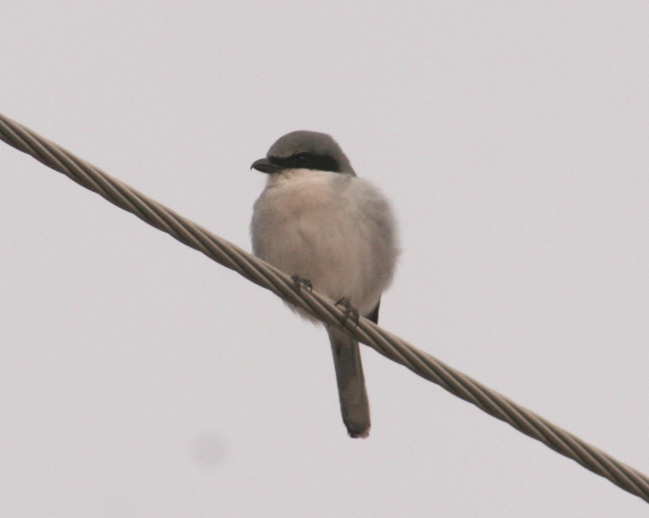 A bit further down the road, I spotted this little guy on my left. I was a little disappointed when I saw that it wasn't a Northern Shrike as I'd hoped (for adding to my photo collection), but rather a Loggerhead Shrike. Note the short bill, and very clean breast - Northerns have longer bills, somewhat streakier breast marks, and a thinner bandito eye-stripe. If there ever was a passerine (i.e., songbird) that deserved mention in the same breath as raptors, it would be a shrike. These birds are sometimes colloquially called "butcherbirds", and for good reason - they often cache their prey (insects, mice, small lizards) by impaling them on thorns or barbs.
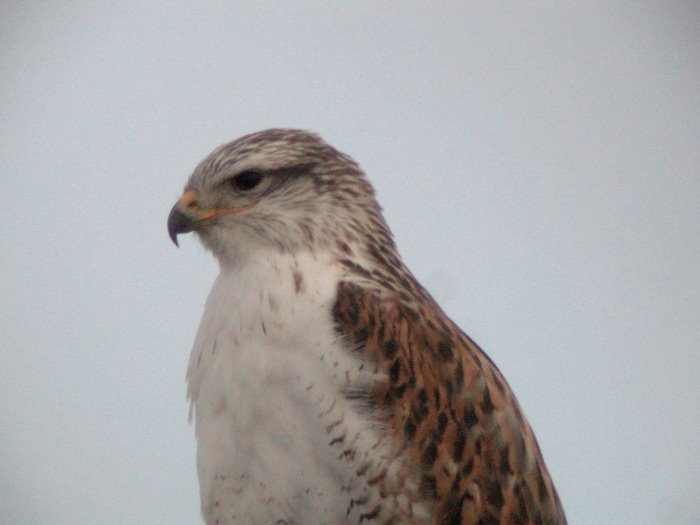 Next up was a highly approachable Ferruginous Hawk, perched on a power pole. I also digiscoped this shot, and for this image I did something a little different, going more for a "portrait" than a full-body pic. Ferruginous Hawks have been wonderfully easy for me to come by so far this year, in contrast to past years where they've been quite rare. What a spectacular bird this is.
Most of the raptors were along the Huerfano River portion of the route, and those were mainly Red-tailed Hawks and American Kestrels. But I did manage to collect one Rough-legged Hawk circling overhead:
 I've been trying to get a shot of one perched, but I've too often approached too closely for them to stay still. In any case, this was my only Roughie for the survey.
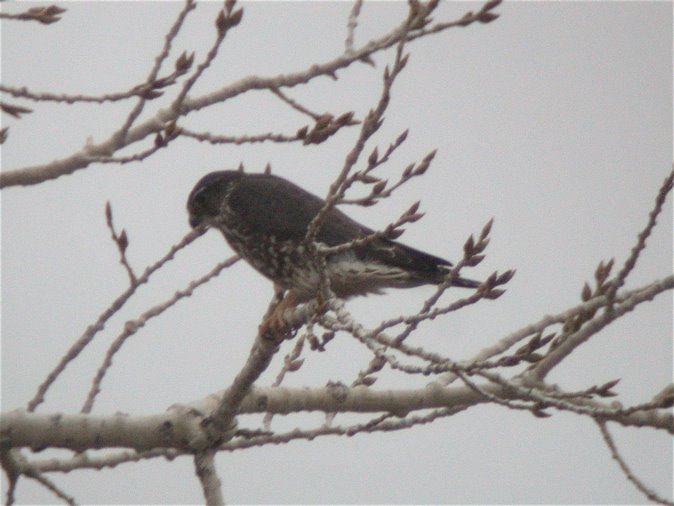 The survey had just ended 10 minutes previous, and I was steaming down Hwy 50 toward Rocky Ford, when something caught my eye out the passenger window. Flying parallel to me was a kestrel-sized bird, more or less, but this was no kestrel, and I knew it right off - no, this was a Merlin. In my excitement I quickly pulled off the road so I could follow its path into a field. I looked around, and a moment later I saw it perched up in a tree a little ways up the road. I scooted up into digiscope range, and got another bad-light falcon-photo. Again a bit dark, but I felt very gratified to have recognized the bird immediately while driving 70 mph in poor light.
The Rocky Ford trip was a bust unfortunately, with the weather turning sour in the afternoon. I retired to the motel in Pueblo that night, and on Friday I headed north in much calmer, clearer conditions to El Paso county, to look for a very special bird indeed - the Long-billed Thrasher*, which had been reported at a private ranch a few weeks earlier. This will likely be only the third recorded instance of this species in Colorado, with the first being nearly a century ago. I had to look for this bird.
* In rare bird alerts, the custom for listing extreme rarities is to capitalize all the letters in the bird name, which makes it very attention-grabbing. Really, it's not just a Long-billed Thrasher, but a LONG-BILLED THRASHER. You can practically hear the urgency as you read the report.
 Anyway, when I arrived at the ranch I found neighbor Nick and Cole already there (those bums!), having seen it just moments earlier. But before we could talk much about it we found the Eastern Towhee hanging around. Unfortunately my angle here isn't so great, and it's hard to see the spotless upperwing coverts that make this an Eastern and not a Spotted Towhee. (These two species used to be lumped.)
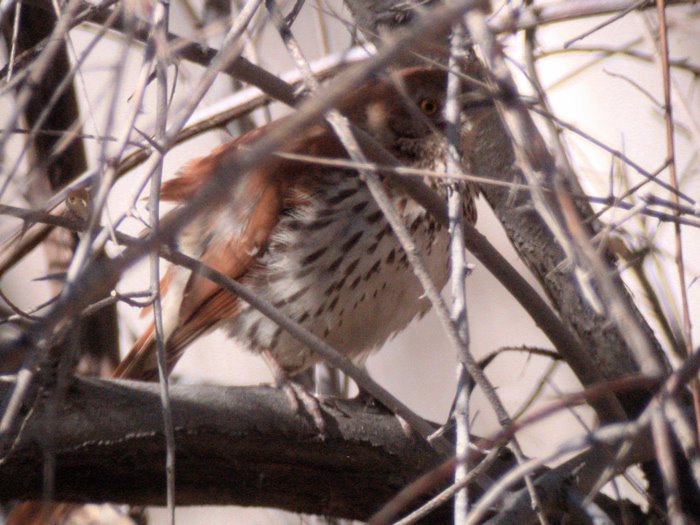 Ah, a thrasher! But dang, it wasn't the one I wanted. This is the Brown Thrasher, a more common variety found in Colorado (although still pretty unusual in the winter months), and in the next couple hours this little bugger would play havoc with my sensibilities, pretending to be the Long-billed and doing a damn good impression of one. Note though, the very rufous coloration and the light brownish breast streaking. I'd also say to look at the relatively short straight bill, but the bird stayed hidden in the twigs, making a clear shot difficult. Hopefully come spring I'll have a nicer Brown Thrasher photo to show. The point is, Browns and Long-billeds look very much alike, but do have clear differences that are perceptible in the field.
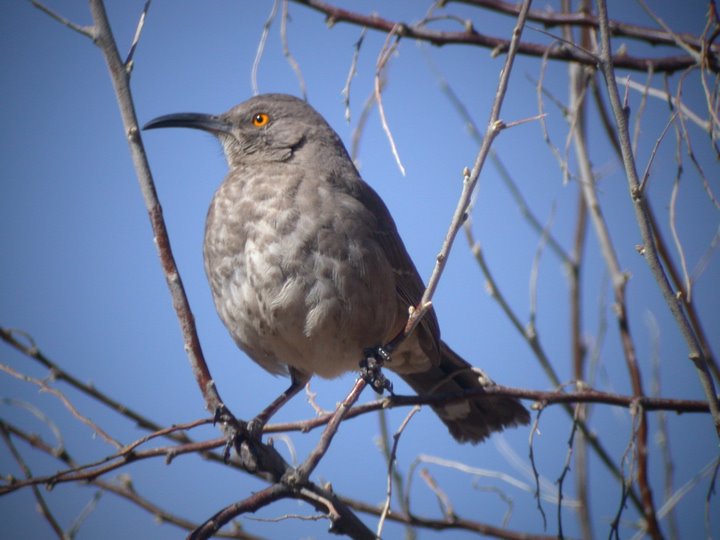 Over there! Now there's a thrasher with a nice long curved bill, like the Long-billed. But no, that's not it either - the bill is actually too long and too curved, and the breast is dull spotted green-gray, not streaked. This is instead the Curve-billed Thrasher, a very nice bird in its own right, although again not uncommon for Colorado. This digiscoped shot was obtained after about 6 crummy attempts, where the bird hid in the branches and caused the camera to focus on twigs instead of the real subject. Patience finally paid off, and the bird obliged with a wonderful pose.
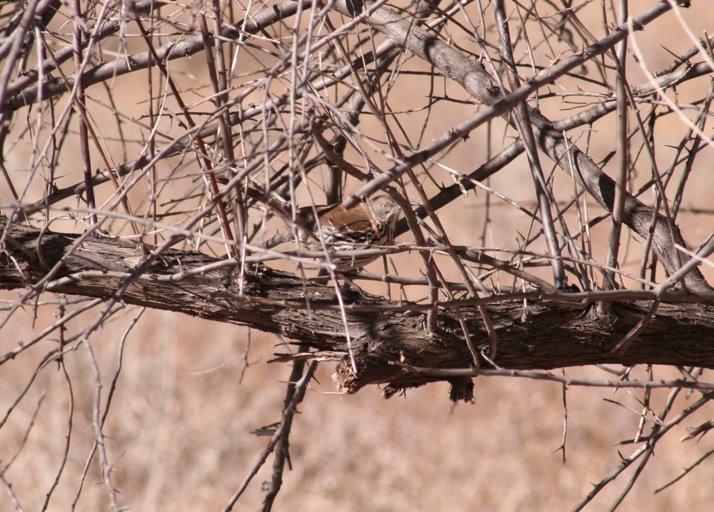 Nick and Cole took off for other locales, leaving me to find the Long-billed on my own. Fortunately, I didn't have to wait too long, and although it skulked in the brambles as advertised (something thrashers love to do in general), it peeked out enough for me to get a few good shots of it. Note here, the much grayer head, the browner back (as opposed to rufous), and the sharper, darker black streaking on the breast. Also, although not seen clearly in this pic, the bill is longer, and curvier than the Brown Thrasher's bill.
Southern and SE Colorado are great places for birding in the state. If this Long-billed is any indication, I can hardly wait for spring migration to roll around.
tags: birds, Colorado, Pueblo, bird photography
Subscribe to:
Posts (Atom)
